
Message from the Executive Director
Dear Adult Family Home Providers,
In the wake of the Washington Supreme Court’s decision in Bolina v. AssureCare Adult Home, LLC, the Supreme Court recognized that live‑in caregivers in adult family homes perform difficult, high‑risk work that deserves the full protections of Washington’s Minimum Wage Act, including minimum wage for all compensable hours and overtime pay after 40 hours in a workweek. While I know a lot of AFHs recognize this, we must be honest about the reality that adult family homes have faced for many years, a reality shaped by the payment system designed and maintained by the State. Adult family homes serving Medicaid residents have operated within a reimbursement structure that has not provided enough funding to support true minimum wage and overtime for live‑in caregivers, even as expectations around staffing, resident acuity, documentation, and quality of care steadily increased. Providers have been asked to do more, with residents who are older, sicker, and require more intensive support, while the rates set by the State have lagged far behind the actual cost of delivering that care.
In that environment, many homes relied on live‑in models and flat daily rates because the Medicaid structure simply did not cover the true cost of 24‑hour care, especially when caregivers were effectively on duty much of the day and night. The intent was not to shortchange caregivers; it was to keep vulnerable residents safely housed, fed, and supported in the only way the current rate system would allow. Most providers were trying to hold together safe, stable homes under reimbursement rates that fell below basic labor standards, not trying to avoid their responsibilities to workers.
When the State pays less than the minimum wage equivalent for the hours of care it requires, and simultaneously excludes live‑in caregivers from full wage and overtime protections, it creates a system in which neither caregivers nor homes can truly succeed. That system has persisted for years. Bolina corrects part of that injustice by recognizing caregivers’ right to minimum wage and overtime, and by acknowledging the hazardous, demanding nature of prolonged live‑in caregiving. But the decision does not fix the underlying funding problem that adult family homes must confront every day. Courts can clarify rights; only the State can ensure those rights are financially sustainable in practice.
The ruling arrives in a funding environment where adult family homes have long operated on thin margins driven by State‑set Medicaid rates. Without corresponding increases in Medicaid reimbursement, homes are now expected to absorb new wage and overtime obligations that the current rate structure was never designed to support. That expectation is not realistic. It forces providers into impossible choices: reducing capacity, altering staffing models in ways that may be less person‑centered, cutting back on services, or in some cases closing altogether. Each of those outcomes directly reduces options for families seeking care, and undermines the goal of keeping people in community‑based settings.
We want caregivers to understand that adult family homes are not the authors of this crisis, they are caught in it. Providers are required to comply with wage laws that we agree are important, but they must do so within a Medicaid payment system that has consistently undervalued both the work caregivers perform and the care residents receive. When the State demands higher standards but does not provide adequate reimbursement, it is asking caregivers and providers to subsidize the true cost of long‑term care out of their own pockets. That is neither fair nor sustainable. And what’s even more disheartening is when the state continues to tell us in negotiations that there is no money for a problem they contributed to.
Our advocacy will continue to focus on the State’s responsibility to fund care at a level that honors both caregivers’ rights and residents’ needs. We are calling on legislators and state agencies to:
• Align Medicaid rates with the real cost of providing 24‑hour care that meets minimum wage and overtime requirements.
• Recognize the higher acuity and complexity of residents served in adult family homes, and the staffing model that safe care demands.
• Invest in a rate structure that allows providers to pay caregivers appropriately, maintain stable operations, and keep beds available for the communities that depend on them.
Adult family homes, caregivers, residents, and families are all part of the same ecosystem. When reimbursement is too low, everyone is harmed. When funding matches the reality of care, everyone benefits: caregivers can be paid fairly, homes can remain open and compliant, and residents can stay in the settings they and their families trust.
Please stay tuned for a webinar we plan to hold on Thursday, July 30, 2026, at 1:30pm where we will attempt to try and answer questions you may have about the Supreme Court ruling and what next steps look like for the AFH Council.
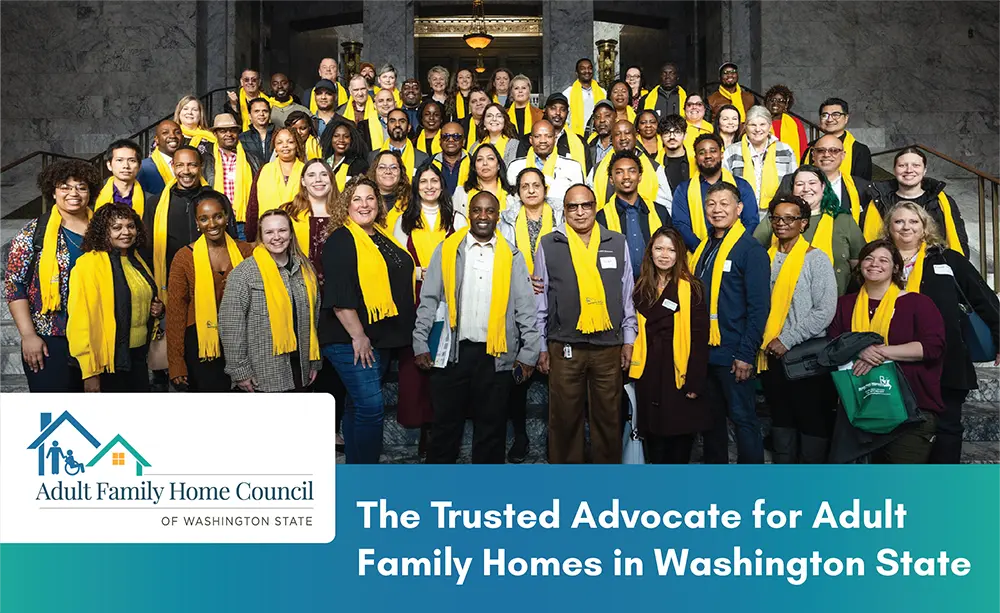
Join the Network of More Than
2,600 Adult Family Homes Today!
Not a Member Yet?
Membership fees enable the Council to cover legal expenses and fund staff to advocate with the state and regulatory agencies. The participation of every adult family home is vital to ensuring fair regulations and rates that accurately reflect the costs of caring for our vulnerable adults. Consider becoming a member of the Council to help us continue improving conditions for all adult family homes in Washington State.