HCS Special Events Training Opportunities Available for AFH Providers
Home and Community Services (HCS) is offering a series of special event trainings focused on mental health, behavior support, crisis intervention, trauma-informed care, and professional self-care. These trainings are available to community providers and caregivers and provide opportunities to expand skills that support person-centered care.
Participants who complete the trainings may receive Continuing Education (CE) credit. To receive CE credit and a certificate of completion, participants must have an account in the appropriate learning system: Learning Center (LMS) for DSHS staff or CareLearn for community providers and caregivers. Certificates will be issued after attendance and completion requirements are verified.
Training Requirements and Important Information
To receive free CE credit, participants must:
- Attend and actively participate for the full duration of the training.
- Complete the feedback survey at the end of the training.
- Join virtual trainings using a desktop or laptop computer through Microsoft Teams.
- Request ASL and/or CART interpreter services at least 60 days before the scheduled training by emailing bstref@dshs.wa.gov.
Upcoming HCS Special Event Trainings
Behaviorism Training: A Provider’s Guide to Behavior Supports (1.5 CEUs)
This training provides an overview of the primary functions of behavior. Participants will learn strategies to assess behavior, identify person-centered interventions, and improve documentation and tracking practices.
Date/Time: September 15, 2026 | 3:00 PM – 4:30 PM
Introduction to Therapeutic Recreation Therapy (1 CEU)
This introductory training provides an overview of Therapeutic Recreation (TR) and how recreation, leisure, and activity-based interventions can support the physical, cognitive, emotional, and social well-being of individuals with illnesses, disabilities, or limitations.
Date/Time: September 2, 2026 | 3:00 PM – 4:00 PM
Reproductive Phases and Mental Health Considerations – Part One (1.5 CEUs)
This training provides an overview of how aging and female reproductive phases may influence mental health and overall well-being. Participants will learn about how life-stage transitions may affect mood, anxiety, trauma responses, sleep, cognition, and daily functioning.
Date/Time: October 27, 2026 | 3:00 PM – 4:30 PM
Reproductive Phases and Mental Health Considerations – Part Two (1 CEU)
Building on Part One, this training focuses on practical applications in service delivery, including documentation, person-centered care planning, and recognizing changes in support needs.
Date/Time: November 3, 2026 | 3:00 PM – 4:30 PM
Trauma of Migration – Part One (1 CEU)
This training introduces the impact of forced migration through a trauma-informed lens. Participants will learn how migration experiences may influence mental health, behavior, communication, trust, and engagement with services.
Date/Time: July 28, 2026 | 3:00 PM – 4:00 PM
Trauma of Migration – Part Two (1 CEU)
This training builds on Part One by focusing on practical strategies for culturally responsive communication, person-centered support, and reducing barriers to care.
Date/Time: August 4, 2026 | 3:00 PM – 4:00 PM
Behavior Support Consultation Available
HCS also offers Behavior Support Consultation for providers with Residential Support Waiver (RSW) contracted clients who are experiencing challenging behaviors that are difficult to manage or who have received a 30-day notice.
Support may include:
- Reviewing Negotiated Service Plans, Negotiated Care Plans, and Person-Centered Service Plans.
- Reviewing Behavior Support Plans and Crisis Plans.
- Providing practical approaches to support stabilization.
- Providing training and education to residential providers and staff.
- Identifying additional resources and assisting with service coordination.
Additional transition support may be available for clients transitioning from a state hospital or acute care setting into an HCS residential setting. Support may include pre-transition consultation, review of behavior support plans, post-transition stabilization support, and resources to help reduce future hospital readmissions.
Providers interested in these training opportunities or behavior support resources are encouraged to register using the links provided for each training.
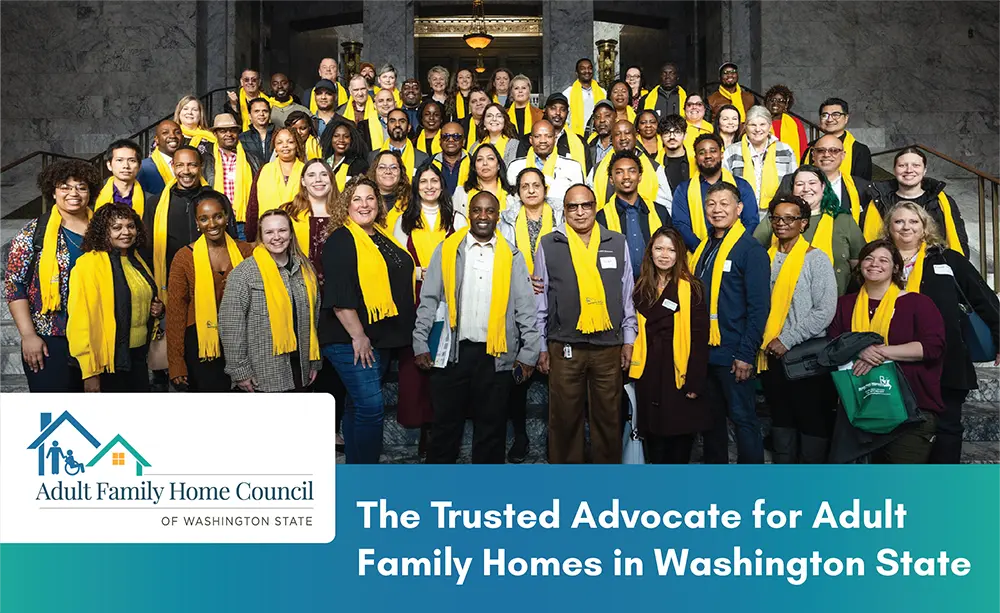
Join the Network of More Than
2,400 Adult Family Homes Today!
Not a Member Yet?
Membership fees enable the Council to cover legal expenses and fund staff to advocate with the state and regulatory agencies. The participation of every adult family home is vital to ensuring fair regulations and rates that accurately reflect the costs of caring for our vulnerable adults. Consider becoming a member of the Council to help us continue improving conditions for all adult family homes in Washington State.