| | AFH COUNCIL UPDATES February 27th, 2026 |
|
| | Executive Director Message |
|
| | Returning to a Weekly AFHC Newsletter Last month we shared the AFHC’s plans to move toward a new monthly magazine-style publication. Our hope was that a monthly format would allow us to present regulatory guidance, legislative updates, training opportunities, and provider resources in a more organized, visually engaging, and in-depth way. As we began developing the first edition, we received thoughtful feedback and practical recommendations from our Director of Education & Publications, Dr. Stacie Thyrion, who helped us evaluate how the new format would work in practice. The monthly magazine was a creative concept and Stacie did a tremendous amount of work helping us bring it to life. At the same time, the experience showed us that the timing is not right for a full transition. As Stacie explained, “This format is labor intensive. Simply put, producing a full magazine each month takes more time than we can realistically maintain while still supporting members in other ways. We also learned that the monthly format is harder to manage when information changes quickly.” Another lesson was that a monthly publication does not replace the need for timely updates. As Stacie pointed out, “The switch to a monthly news magazine has not eliminated the need for time-sensitive updates.” Based on this evaluation, we will be returning with this edition to a weekly AFHC newsletter, distributed on Fridays. In addition, we have decided to combine our Tuesday and Friday communications into one higher-quality weekly newsletter. This combined format will allow us to highlight upcoming webinars, chapter meetings, and events at the end of the week prior, giving providers more time to plan for the week ahead. While we are returning to the weekly format, the magazine concept remains a good idea that we may revisit in the future for non-time sensitive opportunities to share broader based AFH information and stories. The work that went into developing it showed real potential for sharing deeper AFH information with wider audiences and feature articles in a way that is easy to read and save for reference. Our goal at the AFHC remains the same — to provide clear, timely, and practical information that helps Adult Family Home providers succeed. We appreciate the thoughtful work and recommendations that helped guide this evaluation, and we look forward to continuing to improve how AFHC communicates with members. — Bob Schroeter Executive Director |
|
| | Lobby Day 2026: See You at the Capitol! |
|
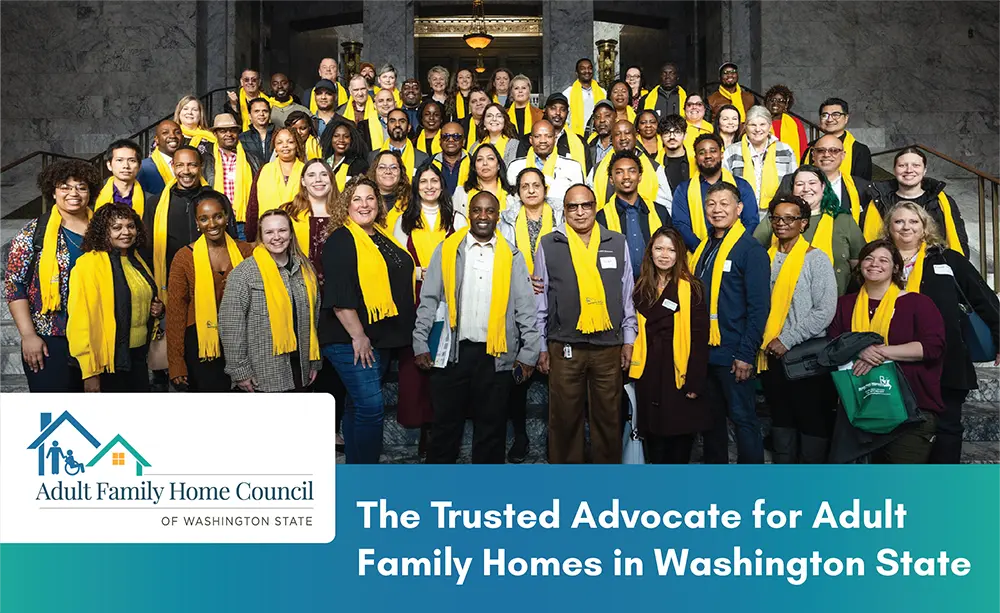
| | We’re excited to see everyone at the Adult Family Home Council’s Lobby Day on Monday, March 2nd at the Washington State Capitol in Olympia. Lobby Day is a powerful opportunity for Adult Family Home providers to connect with fellow members, meet directly with legislators, and advocate for the policies that affect our homes, our residents, and our profession. After a full day of meetings and meaningful conversations at the Capitol, AFHC members are invited to unwind at an evening reception hosted by the Lacey AFHC Chapter. Join us for “The Happiest Hour” at The Heritage Room by Octapas, 604 Water Street SW, Olympia. The evening will feature delicious appetizers, craft cocktails and mocktails, a live DJ, and a photo booth. It will be an opportunity to relax, reconnect, and celebrate the momentum we are building together. We extend a sincere thank you to our Presenting/Tech Sponsor, Synkwise, our Silver Sponsors, ReadyMeds and Care Academy, and our Meal Sponsors, Cornerstone and Redline Attorney at Law. Your generous support makes both our advocacy efforts and this gathering possible. Thank you to everyone joining us in Olympia — we look forward to a powerful day of advocacy together. |
|
| |
| | AFH Council Legislative Update & Budget Overview |
|
| Washington’s 2026 legislative session has reached its midpoint, and budget pressure is shaping nearly every policy discussion. The February revenue forecast added $827 million to the 2025–27 outlook, but the state is still contending with a $1+ billion operating deficit, federal funding reductions, and rising Medicaid and behavioral health caseloads. The House and Senate budgets released this week take different approaches: • Senate budget — Relies on significant cuts and $750 million from the Rainy Day Fund, including reductions across long term care and child care. • House budget — Includes more moderate reductions and a $910 million supplemental capital budget, with nearly $400 million in bonds. Despite these pressures, adult family homes avoided cuts in both proposals. Adult Family Homes in the Crosshairs Long term care settings are often among the first to face reductions during difficult budget cycles. Even before the budgets were released, agencies had begun slowing CBHS and IBSS services, and new federal rules are expected to disqualify thousands from Medicaid eligibility, affecting both AFH residents and providers. What the AFH Council Is Doing for You Protecting adult family home funding and programs remains a top priority. AFHs entered 2026 already strained: • Licensing fees doubled from $225 to $450 per bed • The Meaningful Day program was eliminated • The AFH civil penalty account was swept to fill budget gaps The Council continues to emphasize to lawmakers that AFHs operate on thin margins and provide essential care to some of the state’s most vulnerable residents. The Council is also working with legislators on the potential loss of Medicaid coverage for up to 3,000 individuals in AFHs and nursing homes under federal changes tied to H.R. 1. Budget Outcomes: No Cuts to AFHs, But No Restoration of Meaningful Day AFHs Were Protected From Cuts In a year when many long term care settings saw rate reductions, program rollbacks, and delayed investments, AFHs did not receive cuts in either the House or Senate budgets. This reflects sustained Council advocacy and legislative recognition that AFHs cannot absorb additional reductions. Meaningful Day Was Not Restored Despite strong support from many legislators, neither chamber restored funding for the Meaningful Day program. The reason was not a lack of interest or recognition of the program’s value, it was the state’s fiscal reality. Even with the improved revenue forecast, lawmakers are still facing: • A $1+ billion deficit • Federal funding losses • Rising Medicaid and behavioral health caseloads • Mandatory statutory obligations Legislators consistently expressed support for the program but made clear that there was no available funding to add new spending, even for high value services. The Council continues to advocate for restoration and has ensured lawmakers understand the program’s importance to resident engagement and quality of life. Monitoring Immigration Related Legislation SB 5906 began as a well‑intentioned but overly broad proposal aimed at restricting immigration enforcement officers from entering nonpublic areas of certain facilities without a judicial warrant. While the goal of protecting vulnerable residents was clear, the original bill language would have placed significant new administrative and enforcement obligations on adult family homes—obligations that were never designed with small, homelike care settings in mind. From the moment adult family homes were added to the bill, the AFH Council engaged in intensive, sustained advocacy to ensure the legislation protected residents without creating new liabilities, penalties, or operational burdens for providers. Additional Policy Items and Emerging Issues Several issues on the Council’s legislative agenda are moving forward through administrative channels, including: • TB testing requirements (advocating for 1 year validity for caregivers moving between AFHs) • Addressing referral inequities in adult family homes The Council is also tracking: • SB 6036 – Foster youth placements in AFHs • SB 6436 – Millionaire tax proposal, which could impact AFH owners with multiple businesses • SB 5845 – Timely payment modernization • HB 2340 – Protecting NA credentials after SUD monitoring • SB 6161 – Dementia education resources Staying Engaged As the session enters its final stretch, the AFH Council continues to advocate for policies that protect residents, strengthen the workforce, and ensure the sustainability of adult family homes across Washington. The improved revenue forecast provides some breathing room, but the House and Senate budgets show that long term care remains vulnerable. The Council will continue pushing lawmakers to prioritize stability for adult family homes as final budget negotiations begin. A complete list of active bills and their current status is included below. |
|
| | | | Download the Full Update Here | |
| | AFH Training Network: Why the Council Made the Decision to Designate a New Entity |
|
| Dear Providers, In a packed virtual forum this month, Adult Family Home (AFH) providers heard a detailed explanation of why the AFH Council made the decision to change who operates the Adult Family Home Training Network (AFHTN). The presentation laid out a timeline that many providers had never seen, and raised serious questions about performance, accountability, and the use of provider funded dollars. At the heart of the issue is a simple question: Are AFH providers getting the training results they are paying for? How the Training Network Was Created The AFHTN was created by the Legislature in 2019 through Senate Bill 5672. Before that, AFHs could voluntarily pool resources to train caregivers. But SB 5672 changed everything: it required a portion of provider’s base daily rate be redirected to a centralized training network. In 2020 that funding was 23 cents per client per bed day which came directly out of the Medicaid rate paid to AFHs. In addition to the funding that was set up to go to the AFHTN, the law also required the AFH Council, as the exclusive bargaining representative, to designate the entity that would operate the training network. At the time, the Council designated the Long Term Care Foundation (LTCF). Millions in Funding, But Limited Results According to LTCF’s own budget documents and annual reports, the organization received more than $8.2 million between July 2023 and June 2025 to operate the AFHTN. It is projected to receive another $5.6 million in fiscal year 2026. Yet in the 5 years LTCF has been operating, between January 1, 2020 and June 30, 2025, in their own annual report, they’ve reported that only 700 caregivers completed their HCA or CNA certification through the network. To put that in context: • Washington’s long term care sector faces a projected shortage of more than 14,000 direct care workers by 2030, according to the Washington State Department of Commerce. • AFHs consistently report caregiver shortages as one of their top operational challenges. • The state invests millions each year in workforce development to stabilize long term care. Against that backdrop, the number of completed certifications raised concerns. Other Programs Also Fell Short The Council also highlighted additional programs that were funded because of AFH advocacy, but delivered minimal results under LTCF: Language Access Pilot The Council fought for funding to help caregivers with limited English proficiency complete training. But in two years, LTCF served only 89 individuals, and the state ultimately took the funding back. Health Care Navigation The Council also secured funding to help AFH owners and employees enroll in health insurance. Over two years, LTCF assisted only 175 people statewide. Caregiver Recruitment Recruitment was advertised as a service, but LTCF has provided no data showing how many caregivers were recruited for AFHs. Loss of Council Oversight Raised Red Flags When the AFH Council originally designated LTCF to run the training network, two safeguards were put in place: • Two AFH Council board members were required to sit on the LTCF board. • The AFH Council Executive Director held a guaranteed “Emeritus” seat. But in early 2025, after the former Executive Director was let go, LTCF changed its bylaws: • “Will include two AFHC board members” became “may include up to two.” • The guaranteed Executive Director seat was eliminated. • The Council was not notified of these changes. Without these seats, the Council lost its only formal avenues to advocate for providers or request improvements. Providers’ Dollars, Providers’ Expectations The decision to no longer designate the AFHTN contract with LTCF was not personal, it was about performance, accountability, and the responsible use of provider funded dollars. While LTCF is expected to receive another $5.6 million next year, it currently holds an additional $5.5 million in savings and investment accounts, money that could be used to expand training access, improve language support, or recruit caregivers. Why the Council Acted After reviewing the data, the governance changes, the lack of transparency, and concerns from a large number of providers, the Council concluded that AFH providers deserved better results for the money they are required to contribute. The Council’s duty is to represent all Medicaid contracted AFHs, and that includes ensuring that the training network delivers real value. What Comes Next The Council is in the process of designating a new entity to operate the Adult Family Home Training Network. Providers will receive: • Advance notice before any transition • Clear instructions on what to expect • Support to ensure training access is not disrupted -The AFHC |
|
| Download the AFHTN Forum Slides Here | |
| | Regulatory Advocacy Updates |
|
| Behind the scenes, the Adult Family Home Council works continuously to represent and protect Adult Family Home providers in Washington’s complex regulatory environment. Much of that work happens quietly — in meetings, draft reviews, policy discussions, and negotiations — long before a rule change ever reaches providers’ inboxes. With key leadership from Regulatory Support Director Maleia Press, the Council maintains active dialogue with Residential Care Services (RCS), the Department of Social and Health Services (DSHS), and other regulatory stakeholders. Our goal is simple but critical: to ensure that regulatory expectations remain clear, reasonable, and aligned with the unique home-based model of care that AFHs provide. Below are several active advocacy efforts currently underway. Liability Insurance Alignment Current Washington Administrative Code (WAC) requirements state that Adult Family Homes must carry General Commercial and Professional Liability coverage of $500,000 per occurrence and $1,000,000 aggregate, with no exemptions for specific allegation types. However, the insurance industry has indicated that sub-limits may be acceptable for allegation categories that are not explicitly outlined in WAC. This has created confusion and, in some cases, citations for providers who believed they were in compliance based on guidance from their insurers. The Council is actively working with both the Department and the Office of the Insurance Commissioner to bring clarity and alignment between regulatory language and insurance industry practices. Our objective is to prevent providers from being placed in the middle of conflicting interpretations. If you are currently facing insurance-related compliance concerns, please contact the Council. We can help you understand your options and protect your home from unnecessary citations while this issue is being addressed. TB Testing Requirements The Council has been engaged in ongoing discussions with DSHS regarding TB testing requirements. Current rules create administrative burden and inconsistencies that do not fully reflect updated public health guidance. New draft rule language is expected this spring. The focus is on streamlining the process and aligning Washington State requirements with recommendations from the Centers for Disease Control and Prevention. Our advocacy priority is to ensure that public health protections remain strong while reducing unnecessary procedural hurdles for providers. Medication Error Reporting Rulemaking RCS has initiated rulemaking to align state medication error reporting requirements with federal law. Under the proposal, hotline reporting would only be required when an error results in a call to poison control, an emergency or urgent care visit, hospitalization, or death. This change would reduce reporting of minor incidents while maintaining oversight of serious events. An Interested Parties Meeting was scheduled for February 19, 2026, with a second meeting scheduled for March 9, 2026. Providers are encouraged to participate by registering at the link below. |
|
| Register For the Interested Parties Meeting | |
| | | | AFHC’s Member Support team and Regulatory Support Director continue to closely monitor Dear Provider Letters (DPLs) and share timely guidance to help you stay informed and compliant. Recent updates include clarifications related to newly adopted rule revisions requiring AFHs to maintain resident rosters and post stop placement orders under revised WAC language, gender-neutral terminology updates, and a new definition for “resident representative” as applied to Adult Family Homes, nursing homes, and enhanced services facilities. These regulatory changes are tied to recent rulemaking and proposed updates that may affect compliance timelines and reporting expectations. Some of these updates require action by providers, while others are informational only — and we want to make sure you clearly understand the difference. Read the full breakdown, including what each DPL means for your home and the required timelines, at the link below. |
|
| |
| | | | Several recent updates related to the ProviderOne system may impact Adult Family Home operations in the weeks ahead. Below is a summary of what’s new and what it means for your home. Incorrect Participation Amounts Deducted in January 2026 by ProviderOne The client responsibility amount for some January 2026 claims did not match the amount applied to the Social Services Authorization line in ProviderOne. What this means for you… 1. The Health Care Authority (HCA) is aware of this issue and is working to resolve it. No action is needed from Providers at this time. 2. HCA will provide an update that includes next steps as soon as they have more information. Updated Billing Guide Now Available The Submitting and Adjusting Social Services Claims Guide was updated effective 2/20/2026. What this means for you… 1. The updated billing guide can be accessed below. 2. Providers are encouraged to review the changes that are noted in the Revision History section of the guide. This can be found beginning on page 100 of the Guide. Survey related to ProviderOne Resources DSHS and HCA are seeking feedback from providers on the available ProviderOne resources for Providers (e.g. billing guides, monthly newsletters, FAQs, etc.). The purpose of this survey is to hear from Providers about what resources they find useful, user-friendly, and relevant. What this means for you… Please complete the survey, so your voice is heard! You can complete the survey at the link below. Contacts for ProviderOne Claims Issues If you are having trouble submitting ProviderOne claims, you receive an error message when attempting to enter your claim, or you receive a claim denial, the following steps can be taken to resolve the issue: 1. First review your ProviderOne Authorization List to ensure the authorization is in ‘Approved’ and ‘No Error’ status. a. If the authorization is in ‘Cancelled’ or ‘Error’ status, contact the client’s authorizing case manager. Name and contact information can be found on your Authorization List or the client’s Authorization Letter. b. If the authorization is in ‘Approved’ and ‘No Error’ status: 1) Review the claim to ensure all required fields are complete and accurate. 2) Verify that the information you entered on the claim matches the authorization (i.e., service/procedure code, modifier, units, dates, client ID, authorization #, provider ID). 3) Review the ProviderOne for Social Services Billing Guides to ensure you are billing correctly for the type of service code: a) Service codes with a ‘Day’ unit type can be entered as a date range (e.g., 1/1/2026-1/31/2026) with the total # of units provided for the date range. ProviderOne will split the claim into daily service lines for you. b) Service codes with a ‘1/4 Hour’ unit type or ‘Mile’ unit type can’t be entered as a date range. Codes with these unit types must be entered individually for each date of service and must include the total # of units provided per day. 2. If all of these steps have been followed, and you are still unable to resolve the issue, contact HCA’s Medical Assistance Customer Service Center (MACSC) at 1-800-562-3022 or submit a request online at the link below. a. MACSC will escalate the issue to a supervisor or the DSHS Payments Team as needed to resolve this for you. |
|
| Access the Updated Billing Guide | |
| Access the ProviderOne Survey | |
| Submit an Online Request to HCA | |
| | Save the Dates: Spring Conference Series Returns |
|
| | Mark your calendars. The Adult Family Home Council’s Spring Conference Series is returning this year with three regional events designed to bring practical guidance, regulatory clarity, and peer connection directly to providers across the state. This year’s conferences will focus on strengthening confidence in compliance while sustaining the high-quality, home-based care that defines Adult Family Homes. Spring Conference Dates Auburn – April 29 Vancouver – May 6 Spokane – May 13 Each event will offer focused educational sessions, actionable tools, and opportunities to connect with fellow providers navigating the same regulatory landscape. More details, including the full agenda and registration information, will be released soon. We look forward to gathering with you this spring for a day of learning, clarity, and community. |
|
| | A Message From Member Support |
|
| | Greetings from your Member Support team. We are at that time of year when the daylight hours are increasing! Soon it will be spring. With that in mind we want to help you with some spring cleaning for your Adult Family Home Council contact information. How To Reach Us Member Support is available Monday-Friday, 8:00AM-5:00PM. Here are the best ways to reach us: By phone: (360) 754-3329 or (888) 439-8999 If we are unable to answer, it is because we are helping other members. In those cases, please leave us a voicemail – we will get back to you quickly. By email: info@adultfamilyhomecouncil.org By web form: https://adultfamilyhomecouncil.org/contact-us You can also join us on the 2nd and 4th Thursday of every month for Mornings with Member Support, an informal meeting designed to answer your questions. We heard your feedback regarding the answering service used in recent months and have discontinued our contract with them. Please note that the Member Support team staggers their lunches between 12:00PM and 1:30PM, and as such your call may go to voicemail during that time. What You’re Calling About The Member Support team tracks the questions and issues you bring to us. Here are the top three requests for information from January: TB Testing: What are the TB testing requirements and when are they required? You must have a TB test done for a new hire within 3 days of the date of hire. The ONLY time this is not required is if the new hire has documented proof of a past positive test and you have proof of the positive test or they have proof they have completed treatment for active or latent TB. We have created a frequently asked questions document and flow chart for TB testing, available in the AFHC Document Library linked below. Background Checks: When is the character, competency and suitability assessment required? If a background check indicates the need for the character, competency and suitability check assessment and you decide to hire the person, you should fill out the form and keep it with their file. We have created a flow chart for background checks, available in the AFHC Document Library linked below. Fit Testing: Is fit testing a yearly requirement? Can I become a fit tester for my home? Annual fit testing is a best practice. The Council strongly recommends annual fit testing for staff. If you end up with an infectious illness in your home, you are required to wear N95 masks. If you cannot prove the staff wearing the mask had a fit test in the past year, you will get cited. You can become a fit tester for your home. The link below from the Department of Health includes information on how to complete the training. We also invite you to attend the AFHC webinar, Respirator (N95) Written Program for Adult Family Homes, on March 4th at 2:00PM. Register at the link below. A Thank You To Members Thank you for allowing us to help you provide excellent care. You do that each time you reach out to us for resources or to ask questions. We have the best jobs because we get to talk to you every day. -Maleia, Kris, and Mya |
|
| | Access the AFHC Document Library | |
| Access DOH Fit Testing Information | |
| Register For the N95 Written Program Webinar | |
| Submit a Member Support Help Form | |
| Join Our Next Mornings With Member Support | |
| | Top 5 Cited WACs for 2025 |
|
| 1. WAC 388-76-10530 – Cited 835 times Resident Rights—Notice of Rights and Services The most frequent reason for citations on this topic is failing to review the Notice of Rights and Services and having the Resident and/or their Representative sign and date their acknowledgement at least every 24 months. How to Mitigate: • Create a tickler system to alert the provider 30-60 days prior to the due date, so the provider can ensure these documents are updated on time. 2. WAC 388-76-10430 – Cited 824 times Medication System The most frequent reason for citations on this topic is failing to maintain the list of prescription and over the counter medications for each resident. How to Mitigate: Routinely reconcile medications for all residents in the home, following the steps below: • Review the current list of all prescribed and over the counter (OTC) medications, including the name of the medication, dose and frequency, and the name and phone number of the prescribing practitioner. • Compare medications on hand for the resident against the list, looking for any discrepancies in the medication, dose, and/or frequency. • Confirm all medications have an appropriate verification source. Appropriate sources include any of the following: o Pharmacy produced medication administration record (MAR) (includes both electronic and hard-copy MARs) oPharmacy produced medication label o Physician’s order o Written prescription • Ensure all medications are unexpired (if expired, follow your medication disposal policy). 3. WAC 388-76-10025 – cited 696 times License Annual Fee License fees are always due during the same month in which the home was initially licensed. Typically, when a citation is received it is either because the provider got sidetracked prior to submitting payment, or payment did not get appropriately applied to the account. How to mitigate: • Pay the bill as soon as it is received, so it is not lost in the shuffle. • When submitting, request tracking from the mail service, so you have documentation of payment sent. There are a couple of ways to monitor if your payment has been processed. o Check your bank account to see if the check has cleared your account. o Email the Business Applications and Analysis Unit (BAAU) at baau@dshs.wa.gov and request confirmation payment was received. • Create a tickler system to alert you 15 days before the fee is due, so you can ensure the bill is paid timely. 4. WAC 388-76-10650 – Cited 553 times Medical Devices Providers are commonly cited for not following all the required steps when allowing a resident to utilize a medical device. How to mitigate: • If the resident’s assessment does not already include the device, an updated assessment will be needed to demonstrate whether the resident is able to safely use the device. • Provide documentation to the resident and/or their representative with information about the device’s risks and benefits. It is best practice to have them sign a consent for use that includes acknowledgement they have received this information and are making an informed decision. • Update the resident’s Negotiated Care Plan to include the use of the device • Ensure the device is properly installed. Improperly installed equipment can result in injuries. 5. WAC 388-76-10198 – Cited 530 times Adult Family Home—Personnel Records Providers are frequently cited for not having complete and up to date personnel files for all employees. These files are required to be kept in a place readily accessible to authorized department staff. Files must contain the following information: 1. Staff information such as address and contact information. 2. Staff orientation and training records pertinent to duties, including, but not limited to: a. Training required by chapter 388-112A WAC, including as appropriate for each staff person, orientation, basic training or modified basic training, specialty training, nurse delegation core training, and continuing education. b. Cardiopulmonary resuscitation. c. First aid. d. HIV/AIDS training. 3. Tuberculosis testing results. 4. Criminal history disclosure and background check results as required. How to mitigate: • Develop a system for all employees that maintain the required information in a standard format by topic. This can be done in a binder, or in a filing cabinet. • Develop a tickler system for reminders when certifications are expiring, so they may be updated prior to that date. • Track continuing education credits for all staff. • Establish a process for reviewing files regularly to ensure items are not missed. |
|
| |
|